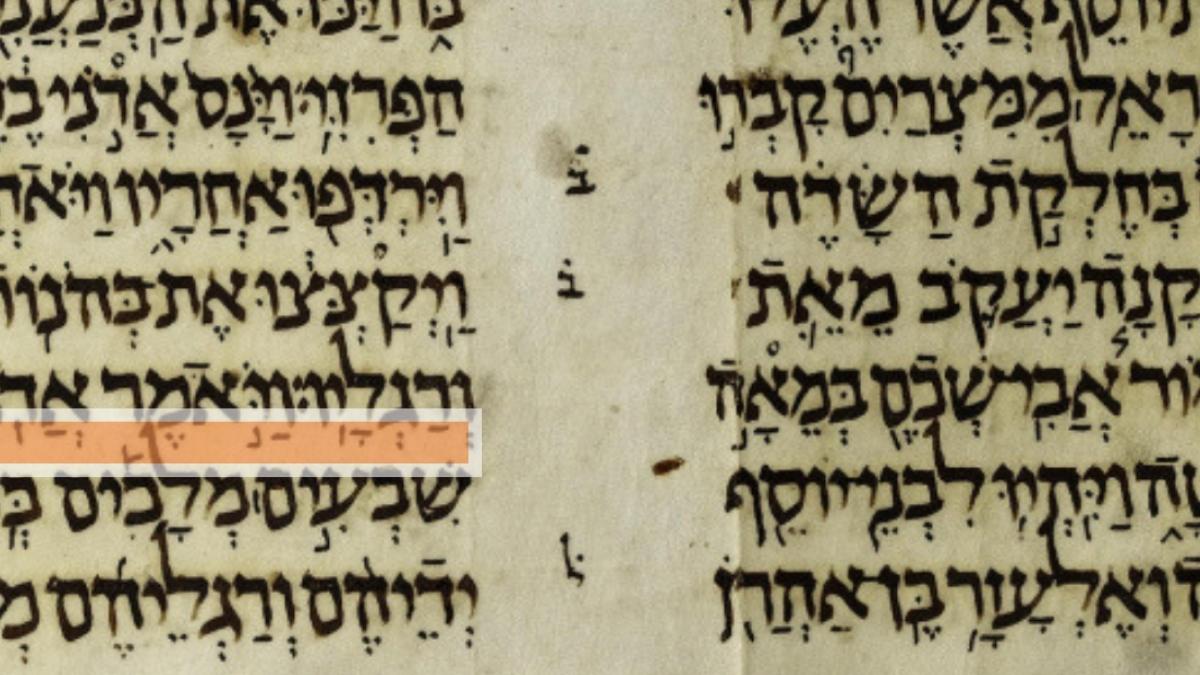
Explore the fascinating world of The Leningrad Codex—a Precious Bible Treasure of Leningrad. Discover its rich history, its role as the faithful representative of the Masoretic Text, its unique artistic embellishments, and its unparalleled importance in modern biblical studies. Join us as we unlock the secrets of this ancient manuscript that continues to be an indispensable resource for scholars, theologians, and anyone interested in the Hebrew Bible.
Dead Sea Scrolls: Unveiling the Mysteries of Old Testament Texts
The Dead Sea Scrolls serve as a pivotal link to the past, revealing new depths to Old Testament texts. From creation to prophecy, these ancient documents shed light on the mysteries of the Bible, providing a richer understanding of the Scriptures and reaffirming their timeless truths.
The Damascus Pentateuch or Codex Sassoon 507 Is a 10th-Century Hebrew Bible Codex
The Damascus Pentateuch, also known as the Codex Sassoon 507, is a 10th-century Hebrew Bible codex that is regarded as one of the most important and valuable manuscripts of the Hebrew Bible. This article provides an overview of the significance, history, and physical characteristics of the manuscript, including its importance in Jewish and biblical studies, the Masoretic Text, and the illuminated decorations.
The Hebrew Old Testament Texts and Versions
Texts and versions provide the raw materials for the discipline known as textual criticism. The ultimate aim is to provide a text in the form intended by its author. Generally speaking, the greater the age of a document, the greater is its authority.
DEAD SEA SCROLLS: The Habakkuk Commentary
The Habakkuk Commentary or Pesher Habakkuk, labeled 1QpHab (Cave 1, Qumran, pesher, Habakkuk), was among the original seven Dead Sea Scrolls discovered in 1947 and published in 1951.
Isaiah Scroll (1QIsaa) AKA the Great Isaiah Scroll
The Isaiah Scroll, designated 1QIsaa and also known as the Great Isaiah Scroll, is one of the seven Dead Sea Scrolls that were first discovered by Bedouin shepherds in 1946 from Qumran Cave 1.
Textual Studies of the Hebrew Bible
The Old Testament, the inspired Word of God, how was it copied, maintained as to the textual reliability, and handed down throughout the past three thousand five hundred years?
DEAD SEA SCROLLS: Ancient Jewish and Hebrew Religious Manuscripts
The Dead Sea Scrolls are perhaps the greatest archaeological discovery of the present century. The seven scrolls were found by a Bedouin in a cave near the northwestern shore of the Dead Sea, in 1947.
Bible Texts and Versions
We must face the reality that while the original 39 OT manuscripts and 27 NT manuscripts were inspired by God [Lit. “God-breathed”] (1 Tim. 3:16), as the authors were moved along by the Holy Spirit (1 Peter 1:21), this was not the case with the copyists thereafter. Yes, hundreds of thousands of scribal errors crept into our manuscripts. Yet, there is ...
Codex Cairensis: A Notable Vellum Hebrew Manuscript of the Hebrew Scriptures
The Codex Cairensis (also: Codex Prophetarum Cairensis, Cairo Codex of the Prophets) is a Hebrew manuscript containing the complete text of the Hebrew Bible’s Nevi’im (Prophets). It has long been referred to as “the oldest dated Hebrew Codex of the Bible which has come down to us.”


