Please Help Us Keep These Thousands of Blog Posts Growing and Free for All
$5.00
Bethel, Map
Introduction
Bethel, meaning “House of God,” is a city of immense significance in biblical history, second only to Jerusalem in terms of frequency of mention in the Scriptures. Situated about ten miles north of Jerusalem, Bethel played a pivotal role throughout various eras of Israel’s history, from the time of the patriarchs to the Maccabean and Roman periods. Its strategic and religious importance is evident from its early association with Abraham, its prominence during the united and divided kingdoms of Israel, and its later fortification and capture by key historical figures. Bethel’s spiritual legacy is both celebrated and condemned in the prophetic writings, highlighting its complex role in Israel’s religious history. Additionally, archaeological excavations have provided further insights into the city’s historical and cultural evolution. This exploration delves into Bethel’s multifaceted history, shedding light on its enduring legacy in the biblical narrative.
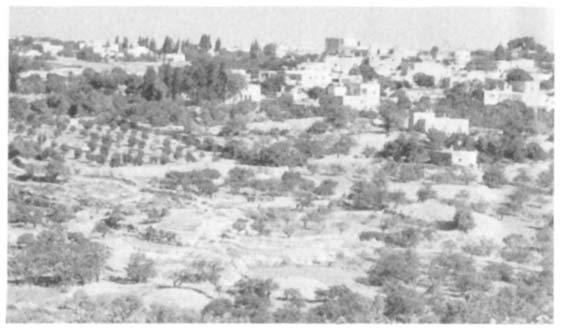
Ruins where ancient Bethel was located. At this city on the roadway that led down to Jerusalem, Jeroboam established a center for calf worship
Bethel in the Days of Abraham
Bethel first appears in the biblical narrative in connection with Abraham, the patriarch of Israel. According to Genesis 12:8, after entering the land of Canaan, Abraham pitched his tent with Bethel on the west and Ai on the east, building an altar to Jehovah and calling on His name. This act of worship signifies Bethel as an early site of devotion and encounter with Jehovah.
Abraham and Sarah in Ur of the Chaldeans
Later, in Genesis 13:3-4, Abraham returns to Bethel after his sojourn in Egypt, again calling upon Jehovah at the altar he had previously made. This return underscores Bethel’s importance as a spiritual landmark in Abraham’s journey. It was here that Abraham reaffirmed his commitment to Jehovah amidst the surrounding Canaanite culture.
The most notable event at Bethel during Abraham’s time is Jacob’s vision, which occurs when Jacob, Abraham’s grandson, fled from his brother Esau. In Genesis 28:10-19, Jacob dreams of a ladder reaching to heaven, with angels ascending and descending on it, and Jehovah standing above it. Jehovah reiterates the covenant promises made to Abraham and Isaac, assuring Jacob of His presence and protection. Upon awakening, Jacob declares, “Surely Jehovah is in this place, and I did not know it” (Genesis 28:16, UASV). He names the place Bethel, setting up a stone pillar and pouring oil on top of it, consecrating it as a sacred site.
Depiction of Jacob’s dream at Bethel
Bethel thus emerges as a key location in the patriarchal narratives, symbolizing divine encounters and covenantal reaffirmations. It served as a geographical and spiritual anchor for Abraham and his descendants, marking significant moments in their relationship with Jehovah.
Bethel During the Period of the Judges
During the period of the Judges, Bethel continued to play a significant role in Israel’s history. It served as a central location for worship and decision-making in the absence of a unified monarchy.
One notable event involving Bethel during this time is recorded in Judges 20-21. After the tragic incident of the concubine in Gibeah, the tribes of Israel gathered at Mizpah to address the crime. Subsequently, they went to Bethel to seek guidance from Jehovah. The Israelites wept, fasted, and offered burnt offerings and peace offerings before Jehovah. They inquired of Jehovah at Bethel, where the Ark of the Covenant was located, seeking His direction in their battle against the tribe of Benjamin. Jehovah responded, providing guidance on their actions, which led to a civil war and the near decimation of the tribe of Benjamin.
Illustration depicting the event from Judges 20-21 involving Bethel.
Bethel also appears in Judges 4:5, where it is mentioned as a place of judgment. Deborah, a prophetess and judge of Israel, held court under the palm tree of Deborah between Ramah and Bethel in the hill country of Ephraim. People from Israel came to her for judgment, indicating Bethel’s significance as a judicial and spiritual center during this period.
Moreover, Bethel was associated with idolatrous practices even during the time of the Judges. Judges 2:1-5 mentions the angel of Jehovah rebuking the Israelites for their disobedience and making a covenant at Bochim, which some scholars believe to be near Bethel. This passage reflects the ongoing struggle of the Israelites to remain faithful to Jehovah amidst surrounding pagan influences.
Thus, Bethel in the period of the Judges was a multifaceted location: a place of divine inquiry and judgment, a center for worship, and a witness to Israel’s faithfulness and failures. Its role during this era underscores its continued importance in the religious and social life of Israel before the establishment of the monarchy.
The Role of Bethel in the United Kingdom of Israel
Bethel’s significance persisted into the era of the United Kingdom of Israel, under the reigns of Saul, David, and Solomon. During this period, Bethel remained a prominent religious site, reflecting the continuity of its sacred status from the patriarchal period through the judges.
Illustration of ancient Bethel
Under King Saul, the first monarch of Israel, Bethel’s religious significance was maintained. Although there are no direct references to Bethel in Saul’s reign, its historical role as a site of worship likely continued. Saul’s reign was marked by attempts to consolidate and unify the tribes of Israel, and Bethel would have been one of the traditional worship centers contributing to this process.
During David’s reign, Bethel continued to be recognized as a significant religious location. King David sought to unify the nation under Jehovah’s worship, which included bringing the Ark of the Covenant to Jerusalem, thereby establishing it as the new religious center. Despite this, Bethel’s historical and spiritual importance did not diminish. David’s respect for established religious sites would have ensured Bethel remained a place of reverence and pilgrimage for many Israelites.
King Solomon, David’s son, further solidified the centralization of worship in Jerusalem with the construction of the Temple. Nevertheless, Bethel’s legacy as a holy site endured. Solomon’s reign, marked by peace and prosperity, allowed for the maintenance of various traditional worship sites, including Bethel. However, Solomon’s later years saw the introduction of idolatry, influenced by his many foreign wives, which eventually contributed to the religious corruption that would later plague Bethel.
Bethel’s role during the United Kingdom was thus one of continued religious significance, albeit overshadowed by the rise of Jerusalem as the primary center of worship. Its historical legacy as a place of divine encounter and covenant remained influential, reflecting the deep roots of Israelite worship practices that predated the monarchy. Despite the centralization of worship in Jerusalem, Bethel’s enduring importance as a religious site highlighted the persistent connection to Israel’s patriarchal and tribal past.
Bethel in the Divided Kingdom: A Center of Idolatry
With the division of the United Kingdom of Israel into the northern kingdom of Israel and the southern kingdom of Judah, Bethel took on a new and controversial role. Under King Jeroboam I of Israel, Bethel became one of the two primary centers of idolatrous worship in the northern kingdom, alongside Dan.
Jeroboam, concerned that his subjects might return to the house of David if they continued to worship in Jerusalem, took measures to establish alternative worship sites. As recorded in 1 Kings 12:26-30, Jeroboam made two golden calves and said to the people, “It is too much for you to go up to Jerusalem. Behold your gods, O Israel, which brought you up out of the land of Egypt.” He set one calf in Bethel and the other in Dan. This act of apostasy marked a significant departure from the worship of Jehovah, directly violating the commandments against idolatry.
Bethel’s transformation into a center of idol worship was further compounded by Jeroboam appointing non-Levitical priests and instituting festivals that mimicked those in Jerusalem. This led to Bethel becoming synonymous with idolatry and spiritual corruption in the northern kingdom. The city’s newfound religious role stood in stark contrast to its earlier associations with patriarchal worship and divine encounters.
The prophets Amos and Hosea vehemently condemned the idolatry centered at Bethel. Amos, who prophesied during the reign of Jeroboam II, denounced the religious practices at Bethel, calling it “Beth Aven,” meaning “house of wickedness” (Amos 5:5, UASV). He warned of impending judgment due to the nation’s sinfulness and the corrupt worship practices that had taken root in Bethel. Hosea also spoke against the idolatry in Bethel, emphasizing Jehovah’s displeasure with the false worship and the consequences that would follow (Hosea 10:5-8, UASV).
The corruption of Bethel’s religious practices continued until the city’s destruction by the Assyrians. The prophetic condemnations highlight how Bethel, once a place of genuine worship, had become a symbol of Israel’s spiritual decline and disobedience to Jehovah. This period in Bethel’s history serves as a stark reminder of the consequences of forsaking true worship for idolatry, illustrating the spiritual and moral degradation that can result from such actions.
Thus, in the divided kingdom, Bethel’s role as a center of idolatry marks one of the darkest chapters in its history, reflecting the broader themes of apostasy and divine judgment that characterized the northern kingdom of Israel.
The Prophets Amos and Hosea: Condemnation of Bethel’s Religious Corruption
The prophets Amos and Hosea played crucial roles in denouncing the religious corruption centered at Bethel during the period of the divided kingdom. Their prophetic messages highlight Jehovah’s disapproval of the idolatrous practices that had taken root in Bethel, which had once been a significant site of genuine worship.
Amos, a prophet from the southern kingdom of Judah, was called by Jehovah to prophesy against the northern kingdom of Israel. His ministry took place during the reign of Jeroboam II (circa 793–753 B.C.E.), a time of relative prosperity but great moral and spiritual decay in Israel. In Amos 7:10-17, we see the confrontation between Amos and Amaziah, the priest of Bethel, who accused Amos of conspiracy and sought to silence his prophetic voice. Amaziah said to Amos, “O seer, go, flee away to the land of Judah, and there eat bread and prophesy there, but never again prophesy at Bethel, for it is the king’s sanctuary, and it is a temple of the kingdom.” Amos responded with a severe prophecy of judgment, indicating the seriousness of Bethel’s corruption.
Amos 4:4-5 sarcastically invites the people to “come to Bethel and transgress,” highlighting the irony of their religious practices, which had become sinful rather than sacred. In Amos 5:5-6, he warns, “Seek Jehovah and live, lest he break out like fire in the house of Joseph, and it devour, with none to quench it for Bethel.” Amos condemned the false sense of security and the empty rituals that had replaced true worship, calling for repentance and a return to seeking Jehovah.
Hosea, a contemporary of Amos, also directed his prophetic message against the northern kingdom, focusing on the unfaithfulness of Israel and the consequences of their idolatry. Hosea’s prophecies, spanning from the reign of Jeroboam II to the fall of Samaria (circa 750–722 B.C.E.), vividly portray the spiritual adultery of Israel. In Hosea 10:5-8, he specifically addresses the idolatry at Bethel, stating, “The inhabitants of Samaria tremble for the calf of Beth-aven. Its people shall mourn for it, and its idolatrous priests shall wail over it, over its glory that has departed from it.”
Hosea 4:15 warns, “Though you play the whore, O Israel, let not Judah become guilty. Enter not into Gilgal, nor go up to Beth-aven, and swear not, ‘As Jehovah lives.'” Hosea’s use of “Beth-aven” (house of wickedness) instead of Bethel (house of God) underscores the extent of Bethel’s corruption. The prophet condemns the false worship that had led the people astray and calls for sincere repentance and return to Jehovah.
The prophetic condemnations by Amos and Hosea illustrate the severity of Bethel’s religious corruption and the broader implications for the northern kingdom of Israel. Their messages serve as a divine indictment against idolatry and a call to restore true worship, highlighting the necessity of faithfulness to Jehovah. The fate of Bethel, as depicted by these prophets, stands as a powerful testimony to the consequences of abandoning Jehovah’s commandments and embracing false gods.
Bethel in the Assyrian and Babylonian Periods
Bethel’s history during the Assyrian and Babylonian periods reflects the broader geopolitical upheavals that affected the northern kingdom of Israel. These eras marked significant changes for Bethel, transitioning from a center of idolatrous worship to a region under foreign domination.
In 722 B.C.E., the Assyrian empire, under King Shalmaneser V and later Sargon II, conquered the northern kingdom of Israel. The fall of Samaria, Israel’s capital, led to the deportation of many Israelites and the resettlement of foreigners in their place (2 Kings 17:6, 24). Bethel, being part of the northern kingdom, fell under Assyrian control during this conquest. The Assyrian policy of deportation and resettlement aimed to destabilize and integrate conquered peoples, thereby preventing rebellion.
The prophetic literature from this period reflects Jehovah’s judgment on Israel, including Bethel, for their persistent idolatry. The prophets had long warned of the consequences of forsaking Jehovah, and the Assyrian conquest was seen as a fulfillment of these warnings. Bethel’s golden calves, introduced by Jeroboam I, were a central symbol of this idolatry and thus central to the prophetic indictments.
Following the Assyrian conquest, Bethel’s religious significance diminished as the city came under Assyrian administration. However, remnants of its idolatrous past lingered, and the mixed population that resulted from Assyrian resettlement practices continued to engage in syncretistic worship, blending Israelite and foreign religious practices. This syncretism is mentioned in 2 Kings 17:24-41, where the inhabitants “feared Jehovah and served their own gods.”
The Babylonian period began with the fall of the Assyrian empire to the Babylonians. In 609 B.C.E., the Babylonians, under King Nebuchadnezzar II, defeated the Assyrians and Egyptians at the Battle of Carchemish, establishing their dominance over the region. By 586 B.C.E., Nebuchadnezzar had conquered Jerusalem and exiled many inhabitants of Judah to Babylon.
While Bethel was not a primary focus of Babylonian campaigns, it fell under Babylonian control along with the rest of the former northern kingdom. The Babylonians, like the Assyrians, practiced deportation and resettlement to maintain control over their empire. The political and social upheaval caused by these conquests further eroded Bethel’s status as a religious center.
Despite the decline in its prominence, Bethel’s historical and spiritual legacy continued to be remembered. The prophetic condemnations and the narrative of Israel’s fall served as a cautionary tale of the consequences of idolatry and disobedience to Jehovah. Bethel’s experience during these periods exemplified the broader themes of judgment and exile that characterized Israel’s history under Assyrian and Babylonian rule.
Bethel during the Assyrian and Babylonian periods transitioned from a significant religious center to a region under foreign control. The Assyrian conquest marked the end of its prominence, while the Babylonian domination maintained the status quo of decline and syncretism. Bethel’s story in these eras serves as a powerful reminder of the consequences of forsaking true worship for idolatry.
Bethel during the Persian Period
The Persian period, which began with Cyrus the Great’s conquest of Babylon in 539 B.C.E., marked a time of significant change and restoration for many regions, including the land of Israel. Under Persian rule, the policies towards subjugated peoples were more lenient compared to the Assyrian and Babylonian empires, allowing for the return and rebuilding of conquered peoples’ homelands. Bethel, like other areas within the former northern kingdom of Israel, experienced these changes during this period.
Cyrus issued a decree in 538 B.C.E. allowing the exiled Jews to return to their homeland and rebuild the Temple in Jerusalem (Ezra 1:1-4). While the focus of the biblical narrative during the Persian period is primarily on the returnees from Judah and the rebuilding of the Jerusalem Temple, Bethel also saw some degree of restoration. The returnees would have included descendants of those from the northern kingdom, and Bethel, being a historically significant location, likely saw renewed settlement efforts.
Cyrus II of Persia (approximately 600-530 BC; Old Persian: 𐎤𐎢𐎽𐎢𐏁 Kūruš), widely recognized as Cyrus the Great, was the influential founder of the Achaemenid Empire, also known as the inaugural Persian Empire. His reign saw the incorporation of all the civilized nations of the ancient Near East into this burgeoning empire, which subsequently extended its influence vastly to encompass most regions of Western Asia and a considerable portion of Central Asia. From the Mediterranean Sea and the Hellespont in the western region to the Indus River in the east, the empire that Cyrus brought into existence represented the most expansive entity the world had witnessed until that time. As his successors carried on his legacy, the Achaemenid Empire reached its pinnacle in terms of territorial coverage, stretching from parts of the Balkans, specifically Eastern Bulgaria-Paeonia and Thrace-Macedonia, in the west to the Indus Valley in the east.
The books of Ezra and Nehemiah provide insight into this period of return and rebuilding. Although Bethel is not directly mentioned in these accounts, it is reasonable to infer that it benefited from the general policies of restoration. The surrounding areas of the former northern kingdom, including Bethel, would have experienced a revival of community life as the exiles returned and reestablished their homes.
Archaeological evidence supports the notion of a resurgence in Bethel during the Persian period. Excavations have revealed artifacts and structures indicating renewed habitation and construction activities. The rebuilding efforts in Bethel would have included restoring homes, agricultural activities, and perhaps even religious structures, although on a smaller scale compared to the Jerusalem Temple.
During this period, the Persian administration established provinces, and the land of Israel was included in the province of Yehud, governed by local Jewish leaders under Persian oversight. The Persian policy of supporting local customs and religions allowed the Jewish community to practice their faith, contributing to a sense of stability and continuity.
Religiously, the returnees sought to reestablish true worship of Jehovah, distancing themselves from the idolatrous practices that had led to their ancestors’ exile. This period saw a renewed emphasis on adherence to the Law of Moses and the rebuilding of the religious community around the Jerusalem Temple. While Bethel did not regain its former prominence as a major religious center, it became part of the broader effort to restore and maintain faithful worship practices.
During the Persian period, Bethel experienced a period of restoration and renewal, benefiting from the policies of the Persian Empire that allowed for the return and rebuilding of Jewish communities. While the primary focus was on Jerusalem and the Temple, Bethel saw renewed settlement and activity, contributing to the overall revival of the land of Israel. The archaeological evidence of habitation and construction during this time underscores Bethel’s ongoing significance in the historical and religious landscape of Israel.
Bethel in the Hellenistic Period and the Maccabean Revolt
The Hellenistic period began with the conquests of Alexander the Great, who defeated the Persian Empire around 331 B.C.E., bringing the land of Israel under Greek control. After Alexander’s death, his empire was divided among his generals, leading to the rule of the Ptolemies and later the Seleucids over Israel. During this era, Bethel, like much of the region, experienced significant cultural and political changes due to the spread of Hellenistic influence.
The image captures Alexander the Great in moments that reflect his military genius and the vastness of his empire, dressed in historically accurate Macedonian attire against a backdrop that symbolizes the diverse territories he conquered.
Under the Hellenistic rulers, there was an increased emphasis on the spread of Greek culture, language, and customs. This period saw the establishment of Greek cities, the construction of Hellenistic-style buildings, and the promotion of Greek religion and philosophy. While some Jewish communities resisted these influences, others adopted aspects of Greek culture, leading to varying degrees of Hellenization.
Bethel, historically a significant site, continued to be inhabited during the Hellenistic period. However, the pressures of Hellenization posed a challenge to the Jewish community’s adherence to their traditional beliefs and practices. The imposition of Greek customs and the influence of Hellenistic religion often led to tensions and conflicts within Jewish society.
The Maccabean Revolt (167-160 B.C.E.) was a critical period for the Jewish people in their resistance against Hellenistic domination, particularly under the Seleucid king Antiochus IV Epiphanes. Antiochus IV attempted to enforce Hellenistic practices and suppress Jewish religious observances, leading to widespread persecution. In response, a group of Jewish rebels, led by Judas Maccabeus and his brothers, rose up against the Seleucid forces, seeking to restore Jewish religious freedom and purity.
Bethel played a strategic role during the Maccabean Revolt. The city, located in the heart of the land of Israel, became a focal point of military and religious activity. The Maccabean forces, driven by their zeal for the Law and their desire to purify the land from pagan influences, engaged in numerous battles against the Seleucid armies and Hellenized Jews who supported the foreign rulers.
One significant event involving Bethel during this period was its fortification by the Syrian general Bacchides around 160 B.C.E. Bacchides, tasked with quelling the Maccabean uprising, fortified several key locations to strengthen Seleucid control. The fortification of Bethel highlights its strategic importance in the conflict between the Maccabean forces and the Seleucids.
Despite Bacchides’ efforts, the Maccabean forces ultimately achieved significant victories, leading to the rededication of the Jerusalem Temple in 164 B.C.E., an event commemorated by the festival of Hanukkah. The success of the Maccabean Revolt resulted in the establishment of the Hasmonean dynasty, which ruled Judea with a degree of independence.
Bethel’s involvement in the Maccabean Revolt underscores its enduring significance as a strategic and symbolic location. The city’s history during the Hellenistic period reflects the broader struggle of the Jewish people to maintain their religious identity and sovereignty amidst foreign domination and cultural pressures.
Bethel during the Hellenistic period and the Maccabean Revolt was a site of cultural conflict and military significance. The city’s fortification by Bacchides and its role in the Maccabean resistance highlight its strategic importance. The period exemplifies the Jewish community’s resilience and determination to preserve their faith and identity in the face of Hellenistic influence and persecution.
Bethel under Roman Rule: The Siege by Vespasian
Bethel’s history during the Roman period is marked by significant events that reflect the broader context of Roman domination over Judea. The Roman conquest of Judea began with Pompey the Great in 63 B.C.E., leading to a period of Roman rule characterized by political upheaval and frequent conflicts. Bethel, with its historical and strategic significance, continued to play a role during this turbulent time.
Josephus before Vespasian
The First Jewish-Roman War (66-73 C.E.) was a major conflict that highlighted the tensions between the Jewish population and the Roman authorities. This war was fueled by various factors, including oppressive Roman taxation, religious restrictions, and the growing resentment of Roman rule among the Jewish populace. Bethel, situated near Jerusalem, found itself involved in the military activities of this period.
One of the pivotal figures in the suppression of the Jewish revolt was Vespasian, a Roman general who would later become emperor. Vespasian was tasked with quelling the rebellion and restoring Roman control over the region. His campaign involved a systematic approach to besiege and capture key Jewish strongholds, employing both military might and strategic acumen.
During Vespasian’s campaign, Bethel was one of the locations that came under Roman siege. The city, with its fortified positions, posed a challenge to the Roman forces. The siege of Bethel was part of Vespasian’s broader strategy to isolate and weaken the Jewish resistance by targeting their strongholds and cutting off their supply lines.
According to historical accounts, Vespasian’s forces were relentless in their assault on Bethel. The Roman legions, known for their discipline and engineering skills, likely constructed siege works and used various tactics to breach the city’s defenses. The siege would have involved significant hardship for the inhabitants of Bethel, as Roman forces aimed to subdue the city through a combination of direct assault and attrition.
The capture of Bethel by Vespasian’s forces was a testament to the Roman military’s effectiveness and the overwhelming power they brought to bear on the Jewish resistance. The fall of Bethel contributed to the eventual suppression of the revolt, culminating in the destruction of Jerusalem and the Second Temple in 70 C.E., a devastating event for the Jewish people.
Following the siege and the subsequent Roman victory, Bethel, like many other cities in Judea, experienced the imposition of Roman authority and control. The city’s strategic location continued to be of importance to the Romans as they sought to maintain order and stability in the region. The aftermath of the siege saw Bethel under the firm grip of Roman administration, contributing to the broader narrative of Roman dominance in Judea.
Bethel under Roman rule, particularly during the siege by Vespasian, highlights the city’s strategic importance and the relentless nature of Roman military campaigns. The siege was a critical event in the First Jewish-Roman War, reflecting the broader struggle between Jewish resistance and Roman authority. The capture of Bethel by Vespasian’s forces underscored the might of the Roman Empire and its determination to maintain control over the rebellious province of Judea.
Archaeological Discoveries at Bethel
Archaeological excavations at Bethel have provided significant insights into the city’s historical and cultural development, confirming its importance throughout various periods of biblical history. These discoveries have helped to illuminate the different phases of Bethel’s occupation and its role in the religious and political landscape of ancient Israel.
The ruins of Beitin, the site of ancient Bethel, during the 19th century
The earliest archaeological investigations at Bethel were conducted in the late 19th and early 20th centuries. However, it was the extensive excavations carried out by William F. Albright and James L. Kelso in the mid-20th century that yielded the most substantial findings. These excavations identified Bethel with the modern village of Beitin, located about ten miles north of Jerusalem.
One of the key discoveries at Bethel is the evidence of continuous occupation from the early Bronze Age through the Iron Age. This continuity supports the biblical accounts of Bethel as a significant settlement from the time of the patriarchs through the periods of the judges, the united and divided kingdoms, and beyond.
Beitin in 1894, from the book Holy Land photographed by Daniel B. Shepp
Significant findings from the early Bronze Age include remnants of fortifications and buildings, suggesting that Bethel was a well-established city even in ancient times. These findings align with the biblical narrative of Bethel being a notable city during Abraham’s time, as mentioned in Genesis.
Early Bronze Age Canaanite ritual site, cut through the bamah by Middle Bronze Age II city wall. Tel Beit El, Beitin, 2017.
From the Iron Age, the period corresponding to the biblical kingdoms of Israel and Judah, archaeologists have uncovered substantial evidence of urban development. Excavations have revealed a large stone wall and gate complex, indicating that Bethel was a fortified city during this period. These structures are consistent with the city’s strategic importance and its role in the defense and administration of the northern kingdom of Israel.
A domed structure in Bethel, 1945
Archaeologists have also discovered a variety of artifacts, including pottery, tools, and inscriptions, which provide further evidence of Bethel’s historical significance. In particular, the presence of religious artifacts and altars suggests that Bethel was an important center of worship. These findings corroborate the biblical accounts of Bethel as a site of both legitimate worship and later idolatrous practices, especially during the divided kingdom period.
Additionally, excavations have uncovered evidence of destruction layers, which align with the historical accounts of various conquests and sieges, including the Assyrian conquest in 722 B.C.E. and the later Roman siege led by Vespasian. These destruction layers provide tangible proof of the turbulent history that Bethel experienced due to its strategic and religious importance.
The Persian and Hellenistic periods are also represented in the archaeological record, with findings indicating continued occupation and rebuilding efforts. Structures and artifacts from these periods reflect the cultural influences and administrative changes that occurred under Persian and later Greek rule. The presence of Hellenistic-style pottery and architecture highlights the impact of Greek culture on Bethel during this era.
Bethel, 1912
Overall, the archaeological discoveries at Bethel offer a comprehensive view of its long and varied history. They validate the biblical narrative by confirming Bethel’s significance across multiple epochs, from its early establishment to its role in the political and religious dynamics of ancient Israel. These findings underscore Bethel’s enduring importance as a historical and cultural landmark, providing valuable insights into the lives and practices of its ancient inhabitants.
Panorama of the city of Bethel.
About the Author
EDWARD D. ANDREWS (AS in Criminal Justice, BS in Religion, MA in Biblical Studies, and MDiv in Theology) is CEO and President of Christian Publishing House. He has authored over 220+ books. In addition, Andrews is the Chief Translator of the Updated American Standard Version (UASV).
SCROLL THROUGH THE DIFFERENT CATEGORIES BELOW
BIBLE TRANSLATION AND TEXTUAL CRITICISM
BIBLICAL STUDIES / BIBLE BACKGROUND / HISTORY OF THE BIBLE/ INTERPRETATION





Thanks for these great insights!
You are very welcome. We find joy in that it is helpful. We publish 6 articles every day on six different Bible subjects. Take care and stay safe.