

Please Help Us Keep These Thousands of Blog Posts Growing and Free for All
$5.00
 |
 |
 |
|
Robert I Estienne
|
|
|---|---|
| Born |
Robert Estienne
1503 Paris
|
| Died | 7 September 1559
Geneva
|
| Nationality | French, Genevan (since 1556) |
| Other names | Robert Stephanus, Robert Stephens, Roberti Stephani |
| Occupation | humanist, printer, publisher |
| Known for | Publishing the Thesaurus linguae latinae |

Paris, the Royal Press, and the Humanist Task
Robert Estienne—Latinized as Robertus Stephanus—worked in the crucible of sixteenth-century Paris, where the revival of classical learning converged with the technical revolution of print. Trained within the distinguished Estienne family business and connected to leading humanists, he combined eloquent scholarship with a fierce commitment to accuracy on the printed page. Under King Francis I, he held royal privileges that opened the doors of the Bibliothèque Royale and gave him access to valuable manuscripts and premier typefaces. The crown’s sponsorship of Greek scholarship brought together copyists, correctors, and type cutters, providing Estienne the tools to print in Greek with a care unseen a generation earlier. The work was not merely mechanical. It was philological: to print the New Testament in Greek responsibly required sifting witnesses, comparing readings, and standardizing orthography, accents, and punctuation so that students and pastors could engage the text with precision. He entered that task with rigor, setting a tone for the centuries that followed.
From Paris to Geneva: Resistance, Revision, and Flight
Estienne is often remembered for his Greek New Testaments, but the immediate controversy that pushed him from Paris centered on his Latin Bible, printed in 1538–1541 with critical notes that challenged the exclusive authority of the Vulgate. He showed—by careful citation of Greek witnesses and early Christian writings—that the Latin text contained readings that required correction or at least caution. The Faculty of Theology (the Sorbonne) reacted strongly. When pressure mounted, the project of accurate biblical printing demanded a freer environment. Estienne moved to Geneva, a city that prized the study of the original languages and welcomed exacting printers. There he continued the work he had begun in Paris: refining the Greek text and equipping readers with a clearer window to the New Testament.
The Four Greek New Testaments: 1546, 1549, 1550, and 1551
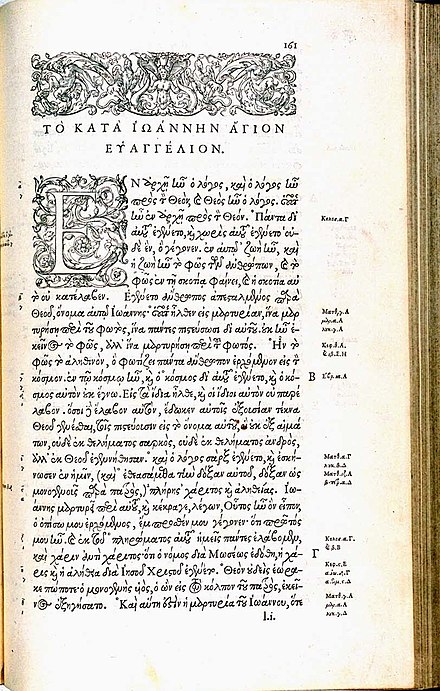
Estienne issued four Greek New Testaments that became landmarks in the printed tradition. The 1546 and 1549 editions refined the existing printed Greek, comparing Erasmus and the Complutensian Polyglot while consulting Greek manuscripts available in Paris. The 1550 edition—popularly called the “editio regia” because of its sumptuous royal Greek type—presented a carefully revised text accompanied by an apparatus of variant readings in the margins. That apparatus, while modest compared with later standards, marked a pivotal step. For the first time in a broadly accessible printed Greek New Testament, readers could see where witnesses diverged and thus learn to weigh evidence. The 1551 edition, printed after his move to Geneva, carried forward the textual work and introduced verse numbers in the New Testament, a feature that transformed reference and study without altering the underlying text.
Estienne’s Marginal Apparatus and the Documentary Method
The heart of Estienne’s scholarly advance lay in his systematic collation of Greek witnesses and his decision to publish these differences. He did not confine himself to conjecture or stylistic preference. He compared documents. By assigning sigla to manuscripts and citing where they agreed or diverged from the printed text, he encouraged readers to think in terms of attestation rather than taste. His practice aligned with a sound documentary method: prioritize external evidence—age, geographical distribution, and independence of witnesses—before invoking internal considerations. In an age when some editors were still tempted to smooth readings on stylistic grounds, Estienne’s habit of reporting the Greek evidence, even when he printed a more familiar reading, cultivated a discipline of transparency. The move was not yet the full-blown apparatus of later centuries, but it was the seed of it, and it taught the learned world to handle the New Testament as a recoverable text anchored in manuscripts.
Royal Greek Types, Breathings, and a New Visual Standard for Greek
Printing the Greek New Testament demanded more than scholarship. It required typefaces capable of representing breathings, accents, iota subscripts, and punctuation with clarity. Estienne’s shop, working with the royal Greek types cut in mid-century, set a new standard in the aesthetics of Greek printing. Correctors in the shop worked through orthography assiduously, normalizing quirks that crept into previous editions and marking diacritics consistently. Because Greek accents in the manuscript tradition are unevenly applied, choices in print inevitably impose a normalized system. Estienne’s careful approach assisted readers in scanning and parsing the text, particularly in the poetic sections, in extended discourses such as John 13–17, and in the dense argumentation of Romans and Hebrews. While accents and punctuation are secondary helps rather than part of the inspired autographs, setting them accurately improves comprehension.
The 1551 Verse Division: What It Is and What It Is Not
In his 1551 Greek New Testament, Estienne divided the text into numbered verses. That innovation accelerated scholarly cross-reference and theological discourse and soon appeared in vernacular editions. The utility is obvious: teachers, students, and translators could point to a precise location quickly. Yet the verse numbers are conventions, not inspired features of the text. The apostles and evangelists wrote continuous prose (and, at points, stylized discourse), not numbered lines. Estienne’s numbering therefore must never be treated as a boundary for exegesis. Clauses sometimes run across verse breaks; parallelism can straddle two or more numbers; and narrative beats do not always align with the divisions. Estienne intended a study tool, not an interpretive grid. When used properly, the numbering enhances study without shaping it.

What Estienne Printed and What His Margins Allowed Readers to See
Because Estienne stood at a transitional moment, the main text of his editions (especially 1550–1551) largely reflected the Greek base that had taken shape through Erasmus’s editions, supplemented by comparison with the Complutensian Greek and a handful of manuscripts. This base tends toward readings often found in later Byzantine witnesses, though individual places vary. Estienne, however, did not conceal alternatives. His margins noted significant differences—an invitation to weigh the evidence.
Consider John 1:18. The earliest Alexandrian witnesses known today attest ὁ μονογενὴς θεός (“the only-begotten God”), while later manuscripts often read ὁ μονογενὴς υἱός (“the only-begotten Son”). Estienne’s printed text followed the reading that had wider currency in the printed tradition, yet the question cannot rest on familiarity. When applying strict documentary principles, earlier papyri and uncials carry decisive weight. The second-century papyri of John, and the venerable fourth-century Codex Vaticanus, support “only-begotten God,” a reading that comports with John’s high Christology and explains the rise of the more common “Son” in later copies. Estienne’s margins encouraged exactly this kind of assessment: ask which witnesses are earliest and most independent, then adjudicate the reading accordingly.
Mark 16:9–20, the longer ending of Mark, illustrates another point. Estienne printed the passage in continuity with the common tradition, as did nearly all printers of his century. Yet a documentary approach asks whether the passage is attested in the earliest and best Greek codices and whether it is known to the earliest patristic commentators. The answer is complex, with early voices acknowledging the shorter ending. Estienne’s edition kept the familiar text for readers, but the apparatus culture he helped foster made it legitimate to ask where the passage is attested and to distinguish between the text printed for ecclesiastical use and the text reconstructed from the combined weight of the earliest witnesses.
John 7:53–8:11, the account of the woman brought before Jesus, likewise stood in the printed text but invites documentary scrutiny. Estienne’s generation did not possess the deep reservoir of early Alexandrian exemplars and papyri now known, yet the very habit of listing variants cultivates the discipline that later scholars applied when richer evidence came to light. When the documentary method is consistently followed, the earliest strata of evidence guide the decision without recourse to conjectural emendation.
Luke 23:34a (“Father, forgive them, for they do not know what they are doing”) exemplifies how to weigh a beloved sentence. The reading is cherished, yet the discipline asks first: where does the early Greek evidence place it? Estienne’s own era sometimes left such questions aside in the main text, but his readiness to note differences lends itself to the sober task of asking which reading best accounts for the rise of the others. The goal is not to prefer difficulty for its own sake, nor to satisfy a stylistic taste, but to state—on the basis of witnesses—what the evangelist wrote.
Estienne and the Comma Johanneum (1 John 5:7–8)
The most discussed passage in the Estienne era is 1 John 5:7–8, the so-called Comma Johanneum. The Latin tradition long printed a Trinitarian gloss between the words about the Spirit, water, and blood. Estienne’s text, following the printed current of his time, included the longer form; yet his work also helped expose the documentary weakness of the Comma. When one asks where the earliest Greek manuscripts stand, the Comma is absent. The rise of the reading is best explained by a Latin marginal gloss that entered the text in the West and then influenced later copies and printed editions. Estienne’s willingness to foreground manuscript differences helped move discussion from polemic to evidence. This is an instance where the discipline of external testimony corrects a reading deeply embedded in the tradition of print.
Estienne’s Collations: What He Saw and What He Could Not Possibly See
Estienne compared many manuscripts available to him through royal and private libraries, but he stood three centuries before the discovery of the earliest New Testament papyri. The discipline he modeled—compare documents, record differences, and let age and distribution matter—aligns perfectly with the wealth of evidence now available. Papyrus witnesses from 100–225 C.E. (for example, P52 [125–150 C.E.], P66 [125–150 C.E.], P75 [175–225 C.E.], P46 [100–150 C.E.]) anchor the text of the New Testament remarkably early relative to the autographs written between 50 and 96 C.E. These witnesses, together with fourth-century uncials such as Codex Vaticanus [300–330 C.E.] and Codex Sinaiticus [330–360 C.E.], allow a reconstruction grounded in documents rather than conjecture. The striking affinity between P75 and Vaticanus in Luke and John—agreeing at a very high rate—demonstrates that the text preserved in key Alexandrian witnesses reflects a form very close to the second-century text, not a late recension. Estienne could not have known this; he died before these discoveries. But the method he normalized—put the variants in the margins and invite readers to inspect the witnesses—harmonizes with this later confirmation.

Greek, Latin, and the Question of Authority in Estienne’s Shop
Estienne’s printing career forced the question of authority into the open. Is the Latin Vulgate the measure of the Greek, or is the Greek the fountain from which the Latin should be corrected? In the sixteenth century, this was not a purely academic debate. Estienne printed the Latin Bible with annotations that compared it to the Greek and Hebrew, revealing places where the Latin needed revision. That stand brought accusations, but it also clarified principles. The New Testament was written in Greek, and the original wording must be sought in Greek documents. Versions (Latin, Syriac, Coptic) are valuable secondary witnesses, often illuminating how a reading was understood in particular regions and centuries. Yet versions do not override Greek documentary evidence. Estienne’s work, by weighting Greek witnesses and reporting their differences, placed the discipline on its proper footing.
The Transmission Timeline Anchored to Literal Chronology
New Testament autographs were produced within living memory of the events they record: the death and resurrection of Jesus occurred in 33 C.E.; apostolic writings appeared from the 50s through the end of the first century. The earliest surviving papyrus fragments and codices carry us within a century of composition for several books. From that base, the text traveled through the centuries by faithful copying, and by the fourth century major codices present the whole New Testament in a stable form. Estienne’s sixteenth-century editions stand far downstream from the autographs chronologically, yet his printed pages reflect the providential preservation of the text through transmission. He did not claim miraculous preservation in any single manuscript line; rather, he treated the text as a historical object recoverable by rigorous comparison of witnesses.
Case Studies Extended: Paul, Acts, and the Gospel Tradition
In Romans 5:1, the variation between ἔχωμεν (“let us have peace”) and ἔχομεν (“we have peace”) turns on a single vowel. Estienne’s text followed the form familiar to his day, but the documentary method examines where early, independent witnesses stand. When the earliest streams favor one form and explain the emergence of the other (for example, a scribal tendency to soften an exhortation into a statement or vice versa), we follow the documents. The same approach governs Acts 20:28, where “the church of God” appears in early Alexandrian witnesses and explains the alternate “church of the Lord.” Estienne’s sense of obligation to note competing readings paved the way for later editors to privilege the earliest attestation rather than a majority of later copies.
In the Gospels, harmonization pressures frequently shaped later copying. At Matthew 1:7–8 and 1:10, the names in the genealogy display small orthographic and onomastic differences that later scribes sometimes “corrected” toward forms they knew. Documentary analysis asks which reading is older and more likely to give rise to the others. Estienne’s inclination to report divergences cautioned readers against assuming that the smoothest text is original. The evangelists wrote in real historical contexts with Semitic names moving through Greek transcription. A later scribe’s tidying does not improve the original; it masks it.
Typography as Philology: How Design Serves Exegesis
Estienne’s typographic decisions are not cosmetic. Good Greek type supports exegesis. Clear distinction of rough and smooth breathing affects the reader’s sense of etymology and, at points, pronunciation that reflects meaning. Accurate accentuation aids the interpreter in identifying the force of particles and the cadence of clauses. Consistent punctuation, though editorial, shapes how readers perceive asyndeton, parataxis, and the boundaries of direct speech. By regularizing these features, Estienne offered a platform for rigorous grammatical analysis that serves the historical-grammatical method. He did not add interpretation; he removed typographic noise so that the grammar and lexicon of the inspired text could be seen as they were written.
The Reorientation of Scholarship: From Conjecture to Witnesses
Before the habit of publishing variants took root, editors could choose readings with minimal accountability. Estienne’s decision to place witnesses in the margin reoriented the discipline. The reader began to ask: What do the earliest manuscripts say? How do they agree? Where do independent lines of transmission coincide? The priority naturally shifted from internal preference to external attestation. Internal evidence—scribal habits, style, immediate context—remains a tool, but it must follow and serve what the documents allow. Estienne’s pages trained scholars to think in those terms. The discipline matured as additional ancient witnesses came to light, but the philosophical anchor—let the manuscripts speak—was already in place.
The Alexandrian Witnesses and the Documentary Center of Gravity
Because the earliest papyri and the fourth-century uncials are predominantly Alexandrian in character, the external evidence centers gravity there, not by decree but by age and independence. P46 grounds the Pauline corpus near 100–150 C.E.; P66 and P75 anchor John and Luke within 125–225 C.E.; Codex Vaticanus and Codex Sinaiticus preserve a full New Testament near the early-to-mid fourth century. Together they testify that the text was stable remarkably early. Estienne could not cite these papyri, but the logic he championed—weight early independent witnesses more heavily than later harmonized majority—receives strong confirmation from them. Where his printed text reflects later readings, his own apparatus culture legitimizes the correction of those places by earlier testimony. The goal is not to favor one “text type” as a matter of allegiance; it is to let the oldest and best-distributed evidence govern the reconstruction.
Geneva, Vernacular Bibles, and the Study Habit Estienne Encouraged
When Estienne’s press settled in Geneva, his Greek work naturally influenced vernacular translators who were determined to work from Greek and Hebrew rather than a single Latin form. The presence of verse numbers in the 1551 Greek New Testament encouraged vernacular editors to align their notes and references precisely. In teaching and preaching, the combination of a stable Greek base text, a habit of consulting variants, and precise referencing multiplied the fruit of language study. The scholarly habits that grew up around his editions—parsing arguments verb by verb in Paul, aligning Synoptic parallels with care, and checking parallel passages without being forced into needless harmonization—owed much to the practical tools he supplied.
Measuring Estienne’s Contribution by the Standards of Textual Criticism
To evaluate Estienne properly, one should not ask whether his main text looks identical to a modern reconstruction based on papyri he never saw. The question is whether he set the discipline on the right trajectory: external, documentary, transparent, and methodical. The answer is yes. By framing the New Testament as a text to be recovered by the testimony of manuscripts, by printing differences without fear, and by elevating the visibility of Greek evidence over tradition, he prepared generations to refine the text where earlier evidence required it and to affirm with confidence where the tradition and the earliest witnesses speak with one voice. In practice, the overwhelming majority of New Testament wording is undisputed across the manuscript tradition. In the comparatively small set of places where variants matter for exegesis, the method Estienne encouraged leads to clarity: earlier, widely distributed witnesses control the decision; later editorial smoothing or liturgical expansions yield to the autograph.

Chronology Touchpoints and the Stream of Transmission
When situated alongside literal Bible chronology, the historical arc clarifies. Jesus was born in 2 or 1 B.C.E. and died in 33 C.E. The apostolic writings span from the 50s through the closing years of the first century. By 100–150 C.E., papyrus witnesses to multiple New Testament books are already in circulation. By 175–225 C.E., additional papyri confirm a stable form of the text. In the early fourth century, complete Greek Bibles appear in codex form. Fifteen centuries after the autographs, Estienne printed the Greek New Testament with scholarly care, modeling a discipline that treats the text as recoverable by documents. Later editors would expand his apparatus, collate more witnesses, and benefit from discoveries unknown to him. Yet the core conviction remains the same: faithful transmission under Jehovah’s providence, verified by manuscripts, restores the original wording for the church’s reading and proclamation.

Estienne’s Mark: Accurate Pages, Open Margins, and a Recoverable Text
A printer “who left his mark” is not one who imposed opinions upon Scripture but one who gave the text room to speak and the reader tools to hear. Estienne’s Greek New Testaments joined typographic excellence to documentary honesty. He normalized the practice of showing one’s evidence. He trained scholars to regard Greek witnesses, versions, and patristic citations as data to weigh rather than barriers to defend. He reminded the learned world that truth gains by being seen. The New Testament text we study today is the beneficiary of that conviction. Where his main text preserved later readings, the apparatus culture he fostered empowered readers to follow earlier evidence. Where his pages were already aligned with the earliest witnesses, his design and accuracy allowed the words to be read without distraction. The long labor of textual criticism is in that sense a continuation of the same craft: set the words before the reader as the apostles and evangelists wrote them, and mark the differences honestly so that sound judgment may prevail.
You May Also Enjoy
Johann Jakob Wettstein (1693–1754): Swiss Theologian and Foundational New Testament Textual Scholar—Life, Method, and His Amsterdam Greek New Testament
About the Author
CLICK LINKED IMAGE TO VISIT ONLINE STORE


