Please Help Us Keep These Thousands of Blog Posts Growing and Free for All
$5.00
Major Critical Texts and Manuscript Abbreviations of the Old Testament
AC: Aleppo Codex AT: Aramaic Targum(s)
B.C.E.: Before Common Era
BHS: Biblia Hebraica Stuttgartensia. Edited by Karl Elliger and Wilhelm Rudolph. Stuttgart, 1984. B 19A: Codex Leningrad c.: Circa, about, approximately LXX: The Greek Septuagint (Greek Jewish OT Scriptures in general and specifically used during of Jesus and the apostles) OG: Original Greek (Oldest recoverable form of the Greek OT (280-150 B.C.E.) SOPHERIM: Copyists of the Hebrew OT text from the time of Era to the time of Jesus. CT: Consonantal Text is the OT Hebrew manuscripts that became fixed in form between the first and second centuries C.E., even though manuscripts with variant readings continued to circulate for some time. Alterations of the previous period by the Sopherim were no longer made. Very similar to the MT. MT: The Masoretic Text encompasses the Hebrew OT manuscripts from the second half of the first millennium C.E. QT: Qumran Texts (Dead Sea Scrolls) SP: Samaritan Pentateuch SYR: Syriac Peshitta TH: Greek translation of Hebrew Scriptures by Theodotion, second cent. C.E. VG: Latin Vulgate
NOTE: Hebrew reads right to left not left to right. So, normally one would start at the right and read back to the left, which might seem strange to the Western mind. However, here we will give you a reverse interlinear, so you can read left to right.
The Dead Sea scrolls are very fragmented here but the Hebrew for “sons of the God” is very clear.
Deuteronomy 32:8 The Septuagint Version of the Old Testament: English Interlinear 8 ὅτε διεμέριζεν ὁ ὕψιστος ἔθνη, ὡς διέσπειρεν υἱοὺς Ἀδάμ, ἔστησεν ὅρια ἐθνῶνκατὰἀριθμὸν ἀγγέλωνθεοῦ
Deuteronomy 32:8 The Septuagint Version of the Old Testament: English Translation 8 When the Most High divided the nations, when he separated the sons of Adam, he set the bounds of the nations according to the number of the angels of God. 9 And his people Jacob became the portion of the Lord, Israel was the line of his inheritance.
Deuteronomy 32:8 The Lexham English Septuagint 8 When the Most High distributed nations
as he scattered the descendants of Adam,
he set up boundaries for the nations
according to the number of the angels of God. 9 And his people Jacob became the portion of the Lord,
Israel an allotment of his inheritance.
Deuteronomy 32:8-9 Updated American Standard Version (UASV)8 When the Most High gave to the nations their inheritance,
When he divided the sons of Adam,[1]
he set the boundaries of the peoples
according to the number of the sons of Israel. 9 For Jehovah’s portion is his people,
Jacob is his allotted inheritance.
Deuteronomy 32:8-9 English Standard Version (ESV)8 When the Most High gave to the nations their inheritance,
when he divided mankind,
he fixed the borders[a] of the peoples
according to the number of the sons of God. 9 But the Lord’s portion is his people,
Jacob his allotted heritage.
Deuteronomy 32:8-9 New Living Translation (NLT)8 When the Most High assigned lands to the nations,
when he divided up the human race,
he established the boundaries of the peoples
according to the number in his heavenly court.9 “For the people of Israel belong to the Lord;
Jacob is his special possession.
The Masoretic Text (MT) has the reading “sons of Israel” (בְּנֵי יִשְׂרָאֵל) in verse 8 of Deuteronomy chapter 32. The Dead Sea Scrolls (QT) has the reading “sons of God” (בְּנֵי הָאֱלֹהִים) in verse 8 of Deuteronomy chapter 32. Most of the Greek Septuagint (LXX) manuscripts have “angels of God” (ἀγγέλων θεοῦ) in verse 8 of Deuteronomy chapter 32. However, it should be noted that the Septuagint manuscript of Aquila (Codex X), Symmachus (also Codex X), and Theodotion also read “according to the number of the sons of Israel.” More on these manuscripts toward the end of the article.
Strongest Argument for the Rendering “Sons of God”
The context of the passage refers to Genesis 10-11 when God divided or separated humankind. We note that Israel is missing from the Table of Nations. Therefore, how can God have set the boundaries for the peoples (pagan nations) according to the number of the sons of Israel (בני ישראל), when they were not even in existence at that time. One textual principle is that the harder reading is preferred. The reading “sons of God” (בני אלהים) is the harder reading because of the implication of divine beings in the text could seem polytheistic, which leads us to our second textual principle. Another textual principle is the reading that the other reading(s) most likely came from is likely the original. This is the fundamental principle of textual criticism. The reading “sons of God” (בני אלהים) is the reading that the others came from. Then we have the difficult question of if it read “sons of Israel” (בְּנֵי יִשְׂרָאֵל) what would be the motivating factor for changing it to “sons of God” (בני אלהים)? The variant could have arisen unintentionally. If intentional, it could have been for the very reason that Michael Heiser suggested below, the reading “sons of Israel” (בְּנֵי יִשְׂרָאֵל) creates a perceived Bible difficulty because it is a reference back to Genesis 10-11, before Israel existed. Or, we simply do not know the motivating factor. The sources for the Masoretic Text, specifically the Allepo Codex, intentionally altered the text because they thought the expression “sons of God” refers to Israel (See Hosea 1:10), so they sought to avoid polytheism, which further supports the reading “sons of God” (בני אלהים) found in the Septuagint/Qumran text. The copyists for the Greek Septuagint altered the text because they thought the reading “sons of God” (בני אלהים) referred to the angelic heavenly beings (Psa. 29:1; 89:6; Psa 82). What we really had in Genesis 10-11 was that God let the pagan nations go to their pagan gods while he took Israel for himself. (See Deut. 32:9; Gen. 12)
The NET Bible Notes Read,
tc Heb “the sons of Israel.” The idea, perhaps, is that Israel was central to Yahweh’s purposes and all other nations were arranged and distributed according to how they related to Israel. See S. R. Driver, Deuteronomy (ICC), 355–56. For the MT יִשְׂרָאֵל בְּנֵי (béney yisra’el, “sons of Israel”) a Qumran fragment has “sons of God,” while the LXX reads ἀγγέλων θεοῦ (angelōn theou, “angels of God”), presupposing בְּנֵי אֵל (béney ’el) or בְּנֵי אֵלִים (beney ’elim). “Sons of God” is undoubtedly the original reading; the MT and LXX have each interpreted it differently. MT assumes that the expression “sons of God” refers to Israel (cf. Hos. 1:10), while LXX has assumed that the phrase refers to the angelic heavenly assembly (Pss 29:1; 89:6; cf. as well Ps 82). The phrase is also attested in Ugaritic, where it refers to the high god El’s divine assembly. According to the latter view, which is reflected in the translation, the Lord delegated jurisdiction over the nations to his angelic host (cf. Dan. 10:13–21), while reserving for himself Israel, over whom he rules directly. – Biblical Studies Press, The NET Bible First Edition Notes (Biblical Studies Press, 2006), Dt 32:8.
Being as balanced as one can be, the choice of what was the original reading between sons of Israel and sons of God is no easy task. This is by far one of the most difficult passages I have had to make a determination as to what the original reading was. The original reading was “sons of Israel” (בְּנֵי יִשְׂרָאֵל), based on the stronger textual support, and other internal evidence mentioned below.
Michael S. Heiser Scholar-in-Residence for Faithlife (Logos) Explanation Of Deuteronomy 32:8 Summarized
The Christian Publishing House Updated American Standard Version (UASV) translates the last half of the verse as follows: “He set the boundaries of the peoples according to the number of the sons of Israel” (Deut. 32:8). The UASV is in line with the Masoretic Text, wherein the final two Hebrew words are “sons of Israel” (בְּנֵי יִשְׂרָאֵל). Michael Heiser makes the argument that some Septuagint and Qumran manuscripts take for granted that a Hebrew text of “sons of God” (בני אלהים or בני אלים) exists. The context of Deuteronomy 32:8 is that it is referring to Genesis 10-11, the Table of the 70 Families or Nations After the Flood with their descendants or areas where they settled. E. J. Hamlin comments in The Interpreter’s Dictionary of the Bible, the Genesis table of nations is “unique in ancient literature … Such preoccupation with history cannot be found in any other sacred literature of the world.” (Edited by G. Buttrick, 1962, Vol. 3, p. 515.) William F. Albright (not a conservative) said that Genesis chapter 10 “stands absolutely alone in ancient literature, without a remote parallel, even among the Greeks, where we find the closest approach to a distribution of peoples in genealogical framework … The Table of Nations remains an astonishingly accurate document.” (supplement to Robert Young, Analytical Concordance to the Bible [Eerdmans], p. 30) Returning to Heiser, he focuses his attention on the fact that, for him, Israel is not found within the Table of Nations and asks how God would set “the boundaries of the peoples according to the number of the sons of Israel” (בני ישראל) – an entity “that did not yet exist.” (p. 53-54)
Heiser’s answer brings Ugaritic literature into the mix with the Hebrew text. He explains, “Literary and conceptual parallels discovered in the literature of Ugarit, however, have provided a more coherent explanation for the number seventy in Deuteronomy 32:8 and have furnished support for textual scholars who argue against the ‘sons of Israel’ reading. Ugaritic mythology plainly states that the head of its pantheon, El (who, like the God of the Bible, is also referred to as El Elyon, the “Most High”) fathered seventy sons, thereby specifying the number of the “sons of El” (Ugaritic, bn il). An unmistakeable linguistic parallel with the Hebrew text underlying the Septuagint reading was thus discovered, one that prompted many scholars to accept the Septuagintal reading on logical and philological grounds–God (El Elyon in Deut. 32:8) divided the earth according to the number of heavenly beings who existed from before the time of creation.”
Heiser goes onto say that “The coherence of this explanation notwithstanding, some commentators resist the reading of the Septuagint, at least in part because they fear that an acceptance of the (בני אלהים or בני אלים) readings (both of which may be translated “sons of gods”) somehow means that Yahweh is the author of polytheism.” It is for this reason, Heiser argues that the Masoretes intentionally altered the Hebrew text, which he contends only adds further support for the Septuagint and Qumran text.
NOTE: Approximately 1,500 texts and fragments have been found to date, all of which have been dated to the 13th and 12th centuries B.C.E. (Huehnergard 2012, p. 3.) Now, ironically, this is secular sources dating secular text, so few will squabble over the dating. However, the Pentateuch (first five books by Moses) was written between 1510 and 1470 B.C.E., a full 200-300 years before the Ugaritic texts. This means that Moses could not have leaned on Ugaritic mythology. It is like other examples of pagan societies taking from the truth of an actual historical event or record and twisting it into mythology, such as all countries in the world having flood legends, some being very close to the true historical account in Genesis.
However, Heiser feels that he unravels that tension of polytheism when one supposedly has a correct understanding of “divine council.” Heiser uses 1 Kings 22:19-23 (cf. 2 Chron. 18:18-22) and Psalms 82, saying there is a likeness with the Ugaritic terminology, which for him provides evidence of other gods. Therefore, he goes on to argue that God assigned the pagan nations to the other gods; then, taking Israel for Himself (See Deut. 32:9; Gen. 12). Even though the evidence raises the issue of a plurality of gods, Heiser says that the people recognized Yahweh as the one and only all-powerful true God. Hence, the Septuagint and the Qumran manuscripts, which for Heiser these are the correspondences with Ugaritic texts, which gives him the rationale for the Masoretic alteration providing the textual evidence that he needs to support “sons of God” as the original reading. In Heiser’s mind, all one needs is a correct understanding of the divine council as it relates to the pagan nations, all the while rejecting polytheism and accepting monotheism, and all of this gives him the support he needs for accepting “sons of God” as the original reading.
The Masoretic Reading Defended As the Original Reading
The Masoretic reading makes perfect sense. We need to understand that it isn’t the pagan Ugaritic texts or any of the Ancient Near Eastern texts that should influence the Word of God. Let’s begin with the fact that the Almighty God is all-powerful and all-knowing. He foresees everything. Then, we need to appreciate that the canonical Bible of sixty-six books are inspired by God, fully inerrant, the authoritative Word of God, as the authors were moved along by the Holy Spirit. What they wrote were the words of God. As for Psalm 82:1, 6, ʼelo·himʹ is used of men, specifically, human judges in Israel. They were seen as gods in their position as human representatives and spokesmen here on earth for the one true God in heaven. Likewise, Moses was informed by God Himself that he was to serve as “God” to Aaron and to Pharaoh. (Ex 4:16; 7:1).
We need to also note that the Dead Sea Scrolls were produced by the Essenes. “Khirbet Qumran was inhabited by members of the Essene sect of Judaism. They formed a kind of “monastic” community, copying biblical texts and creating their own sectarian documents.” (Brotzman, Ellis R.; Tully, Eric J.. Old Testament Textual Criticism: A Practical Introduction, p. 39). The Essenes secluded themselves from society. They believed in mystical ideas about participating with the angels in their worship. The first-century Jewish historian Josephus, describing what a convert to the Essene sect had to observe, he writes: “Moreover, he swears to communicate their doctrines to no one any otherwise than as he received them himself; that he will abstain from robbery, and will equally preserve the books belonging to their sect, and the names of the angels [or messengers]. These are the oaths by which they secure their proselytes to themselves.” (Flavius Josephus and William Whiston, The Works of Josephus: Complete and Unabridged (Peabody: Hendrickson, 1987), 606.). The phrase “sons of God” in the Dead Sea Scrolls is often used as a term for angels (Job 1:6). Therefore, it is not surprising that an Essene text prefers a reference to angels rather than to the sons of Israel. The Essenes, as an isolated sect, had little concern for the other Israelites.
On this Commentator, Albert Barnes writes,
“Some texts of the Greek version have “according to the number of the Angels of God;” following apparently not a different reading, but the Jewish notion that the nations of the earth are seventy in number (compare Genesis 10:1 note), and that each has its own guardian Angel (compare Ecclus. 17:17). This was possibly suggested by an apprehension that the literal rendering might prove invidious to the many Gentiles who would read the Greek version.” (Barnes’ Notes on the Bible, Deuteronomy 32:8).
With the Table of Nations in Genesis 10, we have a full genealogical guarantee that Jesus Christ is the promised, long-awaited Seed. We are aided greatly in establishing chronology back to Adam, something found in no other source. The apostle Paul wrote, “Let every soul be in subjection to the governing authorities. For there is no authority except by God, and those that exist have been placed by God.” (Rom 13:1) The Greek verb that Paul used here, namely, (ὑποτάσσω) hupotassō, means to be placed under the orders of another, bring under control, be in subjection. We need to note that Paul did not say that the “governing authorities” were created by God. God is not the direct Creator of the “governing authorities.” He created humans that rebelled, so indirectly, He has allowed them to come into existence. God even foresaw the “governing authorities” coming into existence. In fact, God foretold them to the extent that he was determined to permit their existence. From the moment that Adam rebelled, God had in mind the relation of these “governing authorities” on earth and how they would interact with his people, the Israelites, leading up to the Seed or offspring of the woman. – Genesis 3:15.
This is evident to us when we consider the ancient Jewish nation of Israel or Jacob. As Moses led the nation of Israel out of Egypt, they passed a number of worldly pagan nations, on their way to the borders of the Promised Land of Canaan. Sitting there on the borders, Moses penned a prophetic song before his death, and in it, he said this: “When the Most High [God] gave to the nations their inheritance, when he divided the sons of Adam, he set the boundaries of the peoples according to the number of the sons of Israel. For Jehovah’s portion is his people, Jacob is his allotted inheritance. Jehovah alone guided him, and there was no foreign god with him.” (Deut. 32:8, 9, 12) Out of this nation and as a result of fulfilled Bible prophecy, there came the virgin birth of Jesus Christ, resulting in the Son of Man, who came to give his life as a ransom for many. (Matt. 20:28) We can now understand why God “set the boundaries of the peoples according to the number of the sons of Israel.” Of the sons of Shem, Eber is named at the beginning of the list (10:21) and again later (10:24) as the word “Hebrew” reasonably comes from his name. God was engaged in bringing about the Seed.
With a similar line of thought, the apostle Paul said to the high court in Athens, Greece: “The God who made the world and everything in it, being Lord of heaven and earth, does not live in temples made by hands, … he made from one man every nation of mankind to live on all the face of the earth, having determinedtheir appointed times and the boundaries of their habitation,that they should seek God, and perhaps feel their way toward him and find him. Yet he is actually not far from each one of us.” (Acts 17:24, 26-27) Yes, God has “determined their appointed times and the boundaries of their habitation” can be seen from the history within the Scriptures. When Abraham, Isaac, and Jacob were roaming throughout the Promised Land of Canaan, God allowed the pagan Canaanites to occupy, maintain and control the land and employ their power and authority there. All the while, Abraham, Isaac, and Jacob had to accept and recognize it, even though they held our faith and hope for the promises God had been making to them.
Psalm 105:13-15 Updated American Standard Version (ASV)
13 And they wandered from nation to nation,
from one kingdom to another people, 14 he allowed no man to oppress them;
he rebuked kings on their account, 15 “Do not touch my anointed ones,
and my prophets do no harm!”
The Table of Families or Nations at Genesis 10 was “not just tracing individual histories, but the development of nations, especially as they related to Israel at the time of the conquest of Canaan. It isn’t a complete catalog of all nations, but rather a list that would help Israel understand the origins of the people they would encounter during the conquest, especially in light of the blessings and cursings of Noah’s oracle (9:25-27). The boundaries of Canaan’s territory are described (10:19) because that is the particular region Israel was to conquer. Many of these lesser-known tribes bordered the land of Palestine. Moses wrote this so that Israel would know who these peoples were in relation to God’s promises of blessing and cursing on the descendants of Noah.” – The Roots of the Nations (Genesis 10:1-32) Steven J. Cole
Most English Bibles have “sons of Israel” or something similar because the translation is based on the traditional Hebrew text of the Old Testament, known to us as the Masoretic Text. But how does God dividing humankind and fixing the boundaries of the peoples “according to the number of the sons of Israel” make any sense? Deuteronomy 32:8 hearkens back to what happened at Babel—and Israel did not exist at that time! If you read through the “Table of Nations” in Gen 10, Israel does not even appear.
Rather than stay with the fact that the one true God is all-powerful and all-knowing, with foreknowledge of every detail that was to come in reference to his people because he was miraculously stepping into history at times to get the desired outcome of his will and purposes, authors like Heiser, they have said, ‘He [God] set the boundaries of the peoples according to the number of the sons of Israel‘ makes no sense; therefore the reading in the Dead Sea Scrolls must be the original reading. Instead of using Scripture to interpret Scripture, they chose to use the Ugaritic texts to interpret Scripture. Authors like Heiser, they have said, ‘He [God] set the boundaries of the peoples according to the number of the sons of Israel‘ makes no sense; therefore, we will skip over the inspired, the fully inerrant Scripture, of men moved along by the Holy Spirit and go to some human historical reason in our selection of what was the original reading, that is, what was found in the Dead Sea Scrolls.
The Septuagint continues to be very much important today and is used by textual scholars to help uncover copyists’ errors that might have crept into the Hebrew manuscripts either intentionally or unintentionally. However, it cannot do it alone without the support of other sources. While the Septuagint is the second most important tool after the original language texts for ascertaining the original words of the original Hebrew text, it is also true that the LXX translators took liberties at times, embellishing the text, deliberate changes, harmonizations, and completing of details. Even so, it should be noted that the Septuagint manuscript of Aquila (Codex X), Symmachus (also Codex X), and Theodotion also read “according to the number of the sons of Israel.”
Brotzman and Tully write,
The earliest of these rival versions (ca. 150 CE) was produced by Aquila, a Jewish proselyte and disciple of Rabbi Akiva. The most noteworthy characteristic of his version is its extreme literalness. He translates the same Hebrew word with the same Greek word, even if the word is not really appropriate in the context, and preserves the same word order as the Hebrew text. … Symmachus was a Samaritan who converted to Judaism and worked at the end of the first century CE. 11 He probably based his work on that of Aquila, but he is much more versatile in his use of vocabulary in order to communicate clearly in Greek. Symmachus adapts Hebrew idioms to Greek usage and does not always use the same Greek word to translate each occurrence of a particular Hebrew word. He may have been attempting to avoid the absurdities of Aquila’s version and to create something much more readable. … The third rival version of the second century CE was produced by Theodotion. He came from Ephesus in Asia Minor and was also a convert to Judaism. Theodotion worked at the end of the second century CE and produced a version located between Aquila and Symmachus in terms of formal correspondence to the Hebrew text (see fig. 4.1 below). He often leaves difficult Hebrew words and constructions untranslated. Some of Theodotion’s distinctive readings were known long before he lived. Therefore, it is likely that he was updating the kaige revision mentioned above. For this reason, and due to confusion and uncertainty of the relationship, some scholars reject this as a distinct translation and refer to it as kaige-Theodotion. – Ellis R. Brotzman; Eric J.Tully. Old Testament Textual Criticism: A Practical Introduction (p. 68-69). Baker Publishing Group.
Some have argued that Deuteronomy 32:43 adds weight to the readings found in the LXX and DSS as opposed to the MT. And this LXX reading seems to be what is followed in Hebrews 1:6.
MT Deuteronomy 32:43: Sing aloud, O you nations, of his people; for he does avenge the blood of his servants and does render vengeance to his adversaries, and he will make atonement for his land, his people.
SP Deuteronomy 32:43: Rejoice, nations, to his people. For he will avenge the blood of his slaves, And will render vengeance on his enemies, And will atone the land of his people.
VG Deuteronomy 32:43: Praise his people, you nations, for he will revenge the blood of his servants: and will render vengeance to their enemies, and he will be merciful to the land of his people.
DSS Deuteronomy 32:43: Rejoice, O heavens, together with him; and bow down to him all you gods, for he will avenge the blood of his sons, and will render vengeance to his enemies, and will recompense those who hate him, and will atone for the land of his people.
LXX Deuteronomy 32:43: Delight, O heavens, with him and worship him, you sons of God. Delight, O nations, with his people and prevail with him, all you angels of God. For he will avenge the blood of his sons, and he will avenge and he will repay the enemies with vengeance, and he will repay those who hate, and the Lord will cleanse out the land of his people.
If the scribe altered the text in 32:8 it is nothing different for the same scribe to do the same in 32:43. You will note above that the LXX has clearly added much to 32:43 and alter much. You will see that the same is true of the DSS. In addition, scribes tend to add material in order to add light, define, explain, strengthen their theology, and so on. Very seldom do they remove material. In addition, we have four textual issues in one verse alone. Also, keep in mind that at Deuteronomy 32:8 the Septuagint manuscript of Aquila (Codex X), Symmachus (also Codex X), and Theodotion also read “according to the number of the sons of Israel.” What we have at Deuteronomy 32:8 is the DSS altering “sons of Israel” in the MT so as to read “sons of God” in the DSS. Then, we have the LXX knowing that the phrase “sons of God” refers to angels, so they alter the DSS “sons of God” so as to read “angels of God” in the LXX.
Three major textual differences here in Deuteronomy 32:43:
Deuteronomy 32:43
דַם־עֲבָדָ֖יו
Call for songs of joy, O nations, concerning his people, for the blood of his servants he will avenge, and he will take reprisals against his foes, and he will make atonement for his land, his people.”
The DSS and LXX have “his children” instead of “his servants.” The DSS and LXX include “and he will repay those who hate him” after “and he will take reprisals against his foes.”
Deuteronomy 32:43
אַדְמָת֖וֹ עַמֹּֽו׃
Call for songs of joy, O nations, concerning his people, for the blood of his servants he will avenge, and he will take reprisals against his foes, and he will make atonement for his land, his people.”
The DSS, LXX, Sam., Syr., Tg., and Vg. have “his people’s land” rather than “his land, his people.”
Deuteronomy 32:43
הַרְנִ֤ינוּ גוֹיִם֙ עַמּ֔וֹ
Call for songs of joy, O nations, concerning his people, for the blood of his servants he will avenge, and he will take reprisals against his foes, and he will make atonement for his land, his people.”
The LXX reads “Rejoice, O heavens, with him, and let all the sons of God worship him. Rejoice, O nations, with his people, and let all the angels of God strengthen themselves in him” in place of “Call for songs of joy, O nations, concerning his people.” This is the reading followed by Heb 1:6.[1]
[1] Rick Brannan and Israel Loken, The Lexham Textual Notes on the Bible, Lexham Bible Reference Series (Bellingham, WA: Lexham Press, 2014), Dt 32:43a–c.
Bastiaan Van Elderen compares three variations of Deuteronomy 32:43, the Song of Moses
Aquila of Sinope was a translator of the Hebrew Bible into Greek, a Jewish proselyte, and disciple of Rabbi Akiva. Aquila, also called Akilas, (flourished 2nd-century C.E.), a scholar who in about 150 C.E. completed an extremely literal translation into Greek of the Old Testament; it replaced the Septuagint (q.v.) among Jews and was used by the Church Fathers Origen in the 3rd century and St. … Jerome in the 4th and 5th centuries. It was so literal that he would use the same Greek word for the same Hebrew word in every instance even if the context demanded otherwise. Without having knowledge of the Hebrew text that lies behind it it is very much difficult to understand.
Symmachus (/ˈsɪməkəs/; Greek: Σύμμαχος “ally”; fl. … late 2nd century) was a Samaritan that converted to Judaism, who would then translate the Old Testament into Greek. His translation was included by Origen in his Hexapla and Tetrapla, which compared various versions of the Old Testament side by side with the Septuagint. It is thought that he used Aquila in his efforts to make his translation but unlike Aquila, he sought to be more varied in his use of the vocabulary to communicate more clearly in Greek.
Theodotion (/ˌθiːəˈdoʊʃən/; Greek: Θεοδοτίων, gen.: Θεοδοτίωνος; died c. 200) was a Hellenistic Jewish scholar, perhaps working in Ephesus, who in c. 150 CE translated the Hebrew Bible into Greek. … In the 2nd century, Theodotion’s text was quoted in The Shepherd of Hermas and in Justin Martyr’s Dialogue with Trypho. The literalness of his version was between Aquila and Symmachus. He left some difficult Hebrew words untranslated. Many believe that he was also using the kaige revision, mention above because many of his readings were actually known before he lived.
These Masoretes were early Jewish scholars, who were the successors to the Sopherim, in the centuries following Christ, who produced what came to be known as the Masoretic Text. The Masoretes were well aware of the alterations made by the earlier Sopherim. Rather than simply remove the alterations, they chose to note them in the margins or at the end of the text. These marginal notes came to be known as the Masora. Between the 6th and 10th centuries C.E., the Masoretes setup a vowel point and accent mark system. (e.g., אִשָּׁה ishshah woman, wife, female) In the image of the Aleppo Codex above, all of the vowels appear below the line except Cholam ( ֹ), which is placed above, and Shuruk ( ִ), which appears in the bosom of Waw (וּ = u). This would help the reader to pronounce the vowel sounds properly, meaning that there would be a standard, and no need to have the pronunciation handed down by oral tradition. Because the Masoretes saw the text as sacred, it needs to be repeated, they made no changes to the text itself but chose to record notes within the margins of the text. Unlike the Sopherim before them, they did not take any textual liberties. Moreover, they drew attention to any textual issues, correcting them within the margins. There were many places within the Hebrew Old Testament text that was far more of a difficult reading to the Masoretes than what we find at Deuteronomy 32:8, yet they made no changes in the text, but rather if there was an alternative reading that they deemed the original reading, they placed this in the margins of the text.
The primary weight of external evidence generally goes to the original language manuscripts. The Codex Leningrad B 19A and the Aleppo Codex are almost always preferred. In the Biblia Hebraica Stuttgartensia (BHS; critical edition of the Hebrew Bible), 90 percent is without a significant variation. Of the 10 percent that does exist, a very small percentage of that has any impact on its meaning, and in almost all of these very limited textual variants, we can ascertain the original wording of the original text with certainty. Yes, it is rare to find a substantive variant among manuscripts of the Hebrew Bible. The Codex Leningrad B 19A dating to about (1008 C.E.) and the Aleppo Codex from about (930 C.E.) were produced by the Masoretes, who are the most by far extremely disciplined copyists of all time, whose scribal practices date back to about the year 500 C.E. In fact, by the second century C.E., a particular text entire Hebrew Bible became the generally accepted standard text, which is often referred to as the Proto-Masoretic text, as it preceded the work of the Masoretes and, it already had the basic form of the Masoretic text that was to come. These subtle differences in the Masoretic manuscripts are almost exclusively spelling differences, which also included vocalization, as well as the presence or absence of the conjunction wāw, in addition to other features that in no way impacts the meaning of the text. In Old Testament Textual Criticism, the Masoretic text is our starting point and should only be abandoned as a last resort. While it is true that the Masoretic text is not perfect, there needs to be a heavy burden of proof in we are to go with an alternative reading. All of the evidence needs to be examined before we conclude that a reading in the Masoretic Text is a corruption.
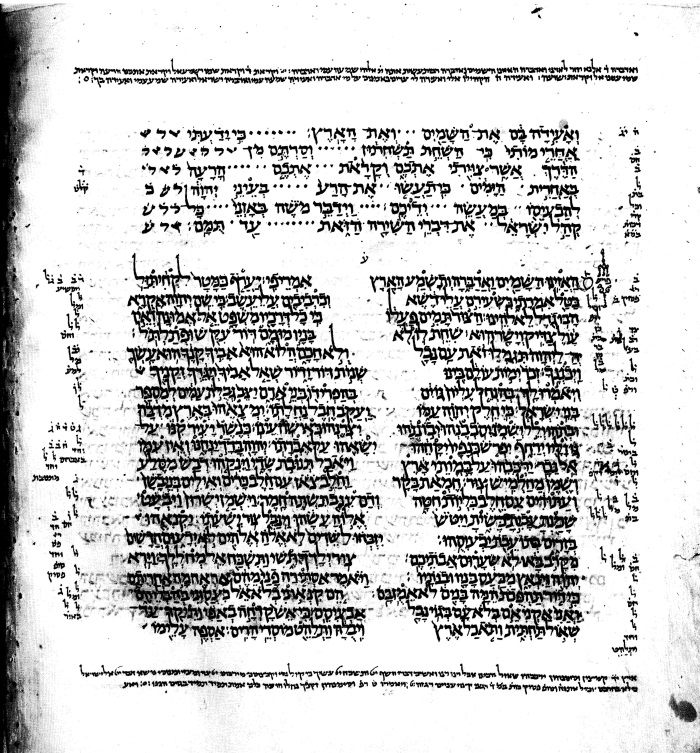
An image of Deuteronomy 31:28 to 32:23 in the renowned Leningrad Codex (B 19A), which dates from 1008 A.D., the world’s oldest complete copy of the Hebrew Scripture and there is no marginal note at Deuteronomy 32:8 expressing and textual issues.
Response to the Comment Regarding Deuteronomy 32:43 and the Alleged Break in Parallelism in the Masoretic Text
READER’S QUESTION
One thing about Deut 32:43 – what about the issue of the break in Hebrew parallelism in the MT? You can see the last couplet is broken in the MT, indicating a line is missing. Given the Hebrew poetic style of the text here, this gives weight to the argument the LXX and DSS versions are the originals. How do you explain this?
Thank you for your thoughtful comment regarding Deuteronomy 32:43 and the potential break in Hebrew poetic parallelism in the Masoretic Text (MT). You suggest that the MT’s shorter reading, which appears to lack a line compared to the longer Septuagint (LXX) and Dead Sea Scrolls (DSS) versions, indicates a missing couplet, potentially supporting the LXX and DSS as more original. Below, I address this claim, arguing that the MT’s structure is poetically complete and that the additional lines in the LXX and DSS reflect later theological expansions rather than a restoration of an original text.
The Masoretic Text: A Complete Poetic Structure
The MT of Deuteronomy 32:43 reads:
“Sing aloud, O you nations, of his people; for he does avenge the blood of his servants and does render vengeance to his adversaries, and he will make atonement for his land, his people.”
(הַרְנִינוּ גוֹיִם עַמּוֹ כִּי־דַם־עֲבָדָיו יִקּוֹם וְנָקָם יָשִׁיב לְצָרָיו וְכִפֶּר אַדְמָתוֹ עַמּוֹ)
You note that the “last couplet is broken,” suggesting an incomplete poetic structure. However, Hebrew poetry, while often employing parallelism, is not bound by rigid rules requiring balanced couplets. The Song of Moses (Deuteronomy 32) frequently uses varied structures to convey its message (e.g., Deut 32:1–3, where imperatives and descriptions blend without strict parallelism). The MT’s text forms a coherent triadic structure:
Imperative: “Sing aloud, O you nations, of his people” calls for praise.
Justification: “For he does avenge the blood of his servants and does render vengeance to his adversaries” explains why praise is due—God’s justice.
Resolution: “And he will make atonement for his land, his people” concludes with God’s redemptive act.
This progression is thematically unified, focusing on God’s earthly justice and covenant with His people. The absence of additional lines does not indicate a “missing” couplet but reflects the concise style of Deuteronomic poetry, which prioritizes theological clarity over symmetrical parallelism.
Comparing the LXX and DSS: Evidence of Expansion
In contrast, the LXX and DSS versions of Deuteronomy 32:43 are significantly longer:
Septuagint (LXX):
“Rejoice, O heavens, with him, and let all the sons of God worship him. Rejoice, O nations, with his people, and let all the angels of God strengthen themselves in him; for he will avenge the blood of his sons and he will avenge and repay the enemies with vengeance, and the Lord will cleanse out the land of his people.”
Dead Sea Scrolls (4QDeutq):
“Rejoice, O heavens, together with him; and bow down to him all you gods, for he will avenge the blood of his sons, and will render vengeance to his enemies, and will recompense those who hate him, and will atone for the land of his people.”
Side-by-Side Comparison Table of Deuteronomy 32:43
Masoretic Text (MT)
Septuagint (LXX)
Dead Sea Scrolls (DSS, 4QDeutq)
Sing aloud, O you nations, of his people; for he does avenge the blood of his servants and does render vengeance to his adversaries, and he will make atonement for his land, his people.
Rejoice, O heavens, with him, and let all the sons of God worship him. Rejoice, O nations, with his people, and let all the angels of God strengthen themselves in him; for he will avenge the blood of his sons and he will avenge and repay the enemies with vengeance, and the Lord will cleanse out the land of his people.
Rejoice, O heavens, together with him; and bow down to him all you gods, for he will avenge the blood of his sons, and will render vengeance to his enemies, and will recompense those who hate him, and will atone for the land of his people.
These texts introduce celestial themes (“heavens,” “sons of God,” “angels”) and additional imperatives, which you cite as evidence of a more complete parallelism. However, their length and elaboration raise questions about their originality. The DSS text, for instance, is fragmentary and relies on reconstruction, weakening its authority. Moreover, the added lines shift the focus from earthly nations to a cosmic scope, aligning with the theological priorities of the communities behind these texts.
Scribal Tendencies: Expansion Over Omission
Textual criticism favors the principle of lectio brevior potior (the shorter reading is preferable), as scribes were more likely to add material than omit it, especially in poetic or liturgical contexts. The LXX and DSS additions reflect known scribal tendencies:
DSS and Essene Theology: The DSS were produced by the Essenes, a sectarian Jewish group with a mystical interest in angels and cosmic worship (e.g., their Songs of the Sabbath Sacrifice). The phrase “bow down to him all you gods” in 4QDeutq echoes this angelology, suggesting an intentional expansion to align with Qumran’s apocalyptic worldview.
LXX and Hellenistic Judaism: The LXX, translated by Greek-speaking Jews in Alexandria, often adapted Hebrew texts to resonate with Hellenistic audiences. References to “sons of God” and “angels” in Deuteronomy 32:43 align with Second Temple Jewish interest in divine beings, as seen in texts like 1 Enoch. These additions enhance the text’s liturgical drama but diverge from the MT’s focus on God’s covenant with Israel.
By contrast, the Masoretes, who preserved the MT, were exceptionally conservative. They meticulously copied the Hebrew text, noting variants in the Masora (marginal notes) rather than altering the consonantal text. Significantly, neither the Aleppo Codex (c. 930 CE) nor the Leningrad Codex (c. 1008 CE) includes a marginal note at Deuteronomy 32:43, indicating no perceived textual issue or missing line. This strengthens the case that the MT’s shorter reading was considered complete by its transmitters.
The New Testament Connection: Hebrews 1:6
You may point to Hebrews 1:6, which quotes a version of Deuteronomy 32:43 resembling the LXX (“Let all God’s angels worship him”), as evidence of the LXX’s originality. However, the New Testament’s frequent use of the LXX reflects its accessibility to Greek-speaking Jews and Christians, not a judgment on its textual superiority. Early Christian writers, like their Jewish contemporaries, used the LXX because it was the standard Scripture in the Greco-Roman world, not because they believed it preserved the original Hebrew better than the MT (see Karen Jobes and Moisés Silva, Invitation to the Septuagint). The quotation in Hebrews 1:6 thus supports the LXX’s influence, not its primacy.
Why the MT Is More Likely Original
To argue that the LXX or DSS preserves the original text, one must explain why the MT—transmitted by a highly disciplined scribal tradition—would omit multiple lines rich with theological significance. Omissions of such content are rare, as scribes typically preserved difficult or controversial readings (e.g., the Masoretes retained challenging texts elsewhere in Deuteronomy 32). Conversely, the additions in the LXX and DSS are consistent with scribal practices of enhancing texts for theological or liturgical purposes. For example:
The LXX’s “Rejoice, O heavens” and “sons of God” introduce a cosmic dimension absent in the MT, reflecting Hellenistic Jewish interests.
The DSS’s “all you gods” aligns with Essene fascination with divine beings, not the mainstream theology of the Hebrew Bible.
Moreover, the MT’s focus on earthly nations and God’s covenant with Israel fits the context of the Song of Moses, which emphasizes God’s justice and relationship with His people (Deut 32:9). The LXX and DSS, by contrast, shift toward a universal, celestial framework, suggesting later reinterpretation rather than an original reading.
Addressing the “Missing Line” Claim
Your concern about a “broken couplet” assumes that the LXX and DSS complete the MT’s parallelism. However, the MT’s triadic structure is poetically sufficient, and the additional lines in the LXX and DSS do not “restore” the text but alter its theological focus. The LXX’s celestial imperatives (“Rejoice, O heavens”) and the DSS’s call for “gods” to bow introduce themes foreign to the Song’s emphasis on God’s earthly judgment. These additions likely reflect the theological agendas of their respective communities, not a correction of a defective MT.
Conclusion
The MT of Deuteronomy 32:43 does not exhibit a break in parallelism but presents a complete, triadic poetic structure consistent with the Song of Moses’ style and theology. The longer readings in the LXX and DSS, while dramatic, reflect scribal expansions driven by Essene and Hellenistic Jewish interests in angelology and cosmic worship. The absence of marginal notes in the Aleppo and Leningrad Codices, combined with the principle of lectio brevior potior and the Masoretes’ conservative transmission, supports the MT as the more original text. Thank you again for raising this important issue, as it highlights the complexity and richness of biblical textual studies.
Please Help Us Keep These Thousands of Blog Posts Growing and Free for All
EDWARD D. ANDREWS (AS in Criminal Justice, BS in Religion, MA in Biblical Studies, and MDiv in Theology) is CEO and President of Christian Publishing House. He has authored over 220+ books. In addition, Andrews is the Chief Translator of the Updated American Standard Version (UASV).
SCROLL THROUGH THE DIFFERENT CATEGORIES BELOW
BIBLE TRANSLATION AND TEXTUAL CRITICISM
BIBLICAL STUDIES / BIBLE BACKGROUND / HISTORY OF THE BIBLE/ INTERPRETATION
Ken M. Penner, The Lexham Dead Sea Scrolls Hebrew-English Interlinear Bible (Bellingham, WA: Lexham Press, 2016)
Martin Abegg Jr., Peter Flint, and Eugene Ulrich, The Dead Sea Scrolls Bible: The Oldest Known Bible Translated for the First Time into English (New York: HarperOne, 1999)
Hi Edward,
Dr Hieser’s position does not seem to counter the fact that the Holy Scriptures as handed down by their original authors is inerrant. He simply re-echoes the historical and universal world view of the supernatural world.
The Biblical writers wrote the human story from the divine perspective. Though the original writers were inspired, the scribes who reproduced their works and the translators were and are not inspired. We having to have this conversation is a proof to this.
I believe that the differences between the texts border on the differences in we have on the world view of the supernatural. This is no trivial issue, seeing how it impacts the way people comprehend and interpret the scriptures. An example is the infamous question by the Sadducees asked the Lord(Matt. 22:23-32)
Now, the existence of other divine beings (gods) does by no means contradict the belief in the existence of the true God (YHWH). In Gensis 32:17, the writer makes pitches YHWH and the other elohim. Revealing that God(YHWH) ,benevolent, gracious and kind, must be revered by them and He alone must they worship. Other elohim are malignant and limited in power, they have not known them and should not revere them.
The writer clearly on one side encourages Israel to worship YHWH and on the other side worn them against Idolatory . The children of Israel knew and served the only true God (YHWH), to them all other divine beings were servants to the One True God. The gentile nations Knew and served hosts of these divine beings (1 Sam 4:8). Each gentile nation believed that their patron God or Goddess occupied the highest seat in the pantheon (Acts 19:17). In the Verse 27 of Acts 19 the so named Diana (divine being) is said have domain in Ephesus and just before this the details concerning the sons of sceva’s ordeal with the man possessed with evil spirit. this certainly is not mere coincidence but the writer was making the case for the existence the rule of malignant supernatural divine being over the city of Ephesus.
Paul states these views in 1 cor. 8:4,5 ‘As concerning therefore the eating of those things that are offered in sacrifice unto idols, we know that an idol [is] nothing in the world, and that [there is] none other God but one. Deut 4:39; Rom 14:14; 1Cor 10:19; Eph 4:6; 5 For though there be that are called gods, whether in heaven or in earth, (as there be gods many, and lords many,) 6 But to us [there is but] one God, the Father, of whom [are] all things, and we in him; and one Lord Jesus Christ, by whom [are] all things, and we by him.’ Which I have been the traditional views of the supernatural world. In conclusion, though God did not need gods yet he made them, though he did not need man yet he made us. Man was made to rule over the earth under God, it is obvious that angels were made to rule over something under God. The narrative of the scriptures is from cover to cover a supernatural one. It is not mere coincidence that all ancient civilization attribute the successes to supernatural entities some of whose names are mentioned throughout the scriptures. These were real, powerful, non-human entities presiding their geographic jurisdictions.
One thing about Deut 32:43 – what about the issue of the break in Hebrew parallelism in the MT? You can see the last couplet is broken in the MT, indicating a line is missing. Given the Hebrew poetic style of the text here, this gives weight to the argument the LXX and DSS versions are the originals. How do you explain this?
SEE THE FULL ANSWER AT THE END OF THE ARTICLE. See the conclusion below.
The MT of Deuteronomy 32:43 does not exhibit a break in parallelism but presents a complete, triadic poetic structure consistent with the Song of Moses’ style and theology. The longer readings in the LXX and DSS, while dramatic, reflect scribal expansions driven by Essene and Hellenistic Jewish interests in angelology and cosmic worship. The absence of marginal notes in the Aleppo and Leningrad Codices, combined with the principle of lectio brevior potior and the Masoretes’ conservative transmission, supports the MT as the more original text. Thank you again for raising this important issue, as it highlights the complexity and richness of biblical textual studies.



very well done article that clears up matters and doe not muddy the waters
Thanks for the feedback.
So where can a copy of the dead sea scrolls and translation screenshot at the top can be obtained?
Ken M. Penner, The Lexham Dead Sea Scrolls Hebrew-English Interlinear Bible (Bellingham, WA: Lexham Press, 2016)
Martin Abegg Jr., Peter Flint, and Eugene Ulrich, The Dead Sea Scrolls Bible: The Oldest Known Bible Translated for the First Time into English (New York: HarperOne, 1999)
http://dss.collections.imj.org.il/
https://www.deadseascrolls.org.il/?locale=en_US
Very enlightening. I have been toiling a few weeks with the teaching of a ‘divine counci’ and have been looking for answers
Hi Edward,
Dr Hieser’s position does not seem to counter the fact that the Holy Scriptures as handed down by their original authors is inerrant. He simply re-echoes the historical and universal world view of the supernatural world.
The Biblical writers wrote the human story from the divine perspective. Though the original writers were inspired, the scribes who reproduced their works and the translators were and are not inspired. We having to have this conversation is a proof to this.
I believe that the differences between the texts border on the differences in we have on the world view of the supernatural. This is no trivial issue, seeing how it impacts the way people comprehend and interpret the scriptures. An example is the infamous question by the Sadducees asked the Lord(Matt. 22:23-32)
Now, the existence of other divine beings (gods) does by no means contradict the belief in the existence of the true God (YHWH). In Gensis 32:17, the writer makes pitches YHWH and the other elohim. Revealing that God(YHWH) ,benevolent, gracious and kind, must be revered by them and He alone must they worship. Other elohim are malignant and limited in power, they have not known them and should not revere them.
The writer clearly on one side encourages Israel to worship YHWH and on the other side worn them against Idolatory . The children of Israel knew and served the only true God (YHWH), to them all other divine beings were servants to the One True God. The gentile nations Knew and served hosts of these divine beings (1 Sam 4:8). Each gentile nation believed that their patron God or Goddess occupied the highest seat in the pantheon (Acts 19:17). In the Verse 27 of Acts 19 the so named Diana (divine being) is said have domain in Ephesus and just before this the details concerning the sons of sceva’s ordeal with the man possessed with evil spirit. this certainly is not mere coincidence but the writer was making the case for the existence the rule of malignant supernatural divine being over the city of Ephesus.
Paul states these views in 1 cor. 8:4,5 ‘As concerning therefore the eating of those things that are offered in sacrifice unto idols, we know that an idol [is] nothing in the world, and that [there is] none other God but one. Deut 4:39; Rom 14:14; 1Cor 10:19; Eph 4:6; 5 For though there be that are called gods, whether in heaven or in earth, (as there be gods many, and lords many,) 6 But to us [there is but] one God, the Father, of whom [are] all things, and we in him; and one Lord Jesus Christ, by whom [are] all things, and we by him.’ Which I have been the traditional views of the supernatural world. In conclusion, though God did not need gods yet he made them, though he did not need man yet he made us. Man was made to rule over the earth under God, it is obvious that angels were made to rule over something under God. The narrative of the scriptures is from cover to cover a supernatural one. It is not mere coincidence that all ancient civilization attribute the successes to supernatural entities some of whose names are mentioned throughout the scriptures. These were real, powerful, non-human entities presiding their geographic jurisdictions.
One thing about Deut 32:43 – what about the issue of the break in Hebrew parallelism in the MT? You can see the last couplet is broken in the MT, indicating a line is missing. Given the Hebrew poetic style of the text here, this gives weight to the argument the LXX and DSS versions are the originals. How do you explain this?
SEE THE FULL ANSWER AT THE END OF THE ARTICLE. See the conclusion below.
The MT of Deuteronomy 32:43 does not exhibit a break in parallelism but presents a complete, triadic poetic structure consistent with the Song of Moses’ style and theology. The longer readings in the LXX and DSS, while dramatic, reflect scribal expansions driven by Essene and Hellenistic Jewish interests in angelology and cosmic worship. The absence of marginal notes in the Aleppo and Leningrad Codices, combined with the principle of lectio brevior potior and the Masoretes’ conservative transmission, supports the MT as the more original text. Thank you again for raising this important issue, as it highlights the complexity and richness of biblical textual studies.